colophon: a deterministic video-qa agent that runs inside trueforge
an agent can write a video plan in seconds. what it still cannot tell you is whether that plan will look good. that gap is the whole job, and for a launch video it is the difference between shipping and embarrassment.
we built colophon to close that gap without pretending a model can judge taste. the trick is to stop asking is this good? and start asking does this spec violate a rule we can name? colophon enforces a closed motion vocabulary and runs fourteen deterministic gates that make zero model calls. it runs inside trueforge as an mcp tool server, so an agent can use it without us ever trusting the model to be the critic.
the gap we kept hitting
the failure mode is always the same. the agent produces a 90-second render. someone watches it and says
it feels cheap, but cannot say why. the defects are real and mechanical: a scene that is
0.2s long, text that overflows its box, a colour that is not the brand colour, a claim with
no source behind it. none of these are a matter of opinion. all of them are checkable by a computer.
| without colophon | with colophon |
|---|---|
| agent ships the render unchecked | agent must clear 14 named gates first |
| does it look good? becomes a model guess | gate returns a code and a fix, not a vibe |
| defect found by a human after publish | defect located and blocked before launch |
| taste is a feeling re-litigated every render | taste is a parameter, set once |
lint the spec, not the pixel
one constraint explains almost everything we built: you cannot lint a pixel, but you can lint a
spec. so we never let the agent author from nothing. we give it a closed motion vocabulary,
a finite set of moves, each with explicit parameters. once motion is a number (400ms,
60ms stagger, scale 1.05), taste becomes a parameter you can set, version, and
enforce. a verdict becomes located instead of interpreted: the pulse feels cheap maps
onto one of three dials, vocabulary, parameters, or precondition, and a single edit makes it true for
every future video.
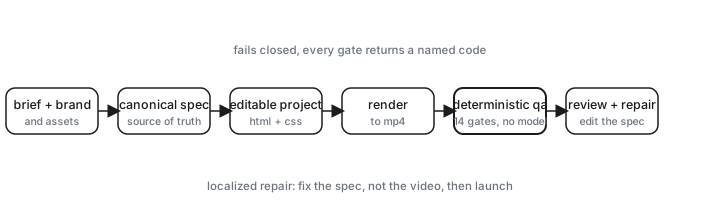
run the gates as a tool, not a wrapper
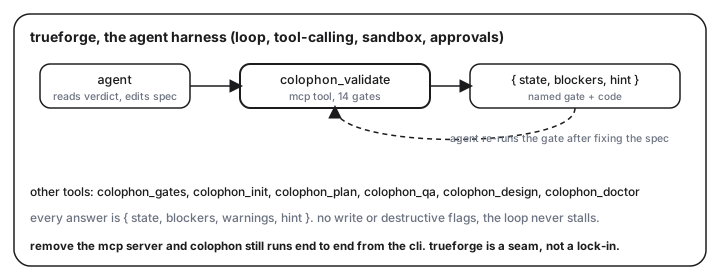
colophon is an instrument, not an employee. it reports what is wrong with a spec; it does not decide what to do about it. trueforge is the environment the agent works inside, the loop, the tool calling, the sandbox, the approvals. so colophon runs inside trueforge as an mcp tool server, and the agent does the actual work of reading a report and acting on it.
the crucial difference from a wrapper: the agent is not asking a model is this video good? on boundary defects that is close to a coin flip. it calls a deterministic instrument, reads a precise answer that names the gate and the failure code, and acts. trueforge supplies the loop; colophon supplies the ground truth.
a loop you can watch
in a trueforge session the agent calls colophon_validate and gets back a precise, named
verdict, never a vague opinion. here is a real shape of the answer:
{
  "gate": "spec.timing.min_scene_ms",
  "state": "blocked",
  "blockers": ["scene 'hook' is 0.2s (< 400ms minimum)"],
  "warnings": [],
  "hint": "A scene this short reads as a flash; raise to >=400ms or merge into the next scene."
}
the agent reads the blocker, edits the spec, and re-runs the gate. when the named defect is gone, the gate
returns ready. that is the entire interaction: a loop of name the failure, fix the cause,
re-check, with no human in the middle guessing.
why the gates hold the veto
a wrapper puts the model in charge and treats the checker as a suggestion. we did the opposite. when a spec
is not ready, a gate says blocked with a specific code, and the agent's only move is to fix the
underlying cause. this is also why the system is demoable with zero api keys: trueforge runs
standalone, and colophon's gates make no model calls at all. the ground truth is free; only the agent that
acts on it needs a model.
honesty by design
three rules keep the system trustworthy. each has a named failure mode and a fix.
- no model calls in the gates. a verdict is computed, not guessed. failure: a gate that asks the model if it looks fine. fix: delete the call; if it cannot be computed, it is a blocker.
- the taxonomy fails closed. if a gate cannot check something because the artifact does not exist yet, that is a blocker, not a pass. failure: returning ok on missing input. fix: count missing prerequisites as blocked.
- independent review builds a contact sheet.
colophon reviewextracts frames a human signs off on. failure: shipping on the instrument's word alone. fix: require a human verdict on the contact sheet before launch.
what is actually under the hood
- fourteen deterministic gates. spec-level gates (vocabulary, parameters, preconditions, source
grounding) run before any artifact exists; artifact-level gates (timing, overflow, contrast, brand-colour
compliance, claim support) run after render. every gate returns
{ state, blockers, warnings, hint }. - a canonical spec. the spec is the source of truth, a closed vocabulary of moves with explicit parameters. you lint the spec, not the pixels.
- a bounded repair loop (
colophon design). headless, no agent, no api key: it localizes a failure to one of three dials and applies a targeted spec edit, then re-runs. fails closed. - a reproducible fingerprint. every render records the spec hash, each qa stage, and the resolved
runtime into
delivery-report.json, so a result replays instead of being admired. - why an instrument beats a model opinion. on boundary-defect judgement, models score f1 11 to 42 (ui-lens, cvpr 2026), close to a coin flip. colophon returns a named gate and a failure code, not a vibe.
- ten adrs. the trades are written down: fail-closed taxonomy, opt-in agent invocation,
skip-versus-fail honesty, never silently substituting a missing field.
tests/test_docs.pyfails the build if the prose drifts from the code. - demoable with zero keys. trueforge runs standalone; the gates make no model calls.
colophon deliverruns end-to-end from the cli.
run it
# serve colophon's gates as mcp tools
colophon mcp serve --host 127.0.0.1 --port 8000

# in another terminal, start the harness (no signup, local sandbox)
npx @truefoundry/trueforge@latest        # listens on :8790

# or run the whole pipeline headlessly, no agent, no key
python3 -m colophon.cli deliver runs/cadence-01 --review
in trueforge: settings, mcp servers, add. type remote, url
http://127.0.0.1:8000/mcp. then watch the agent call colophon_validate, hit a
named blocker, edit the spec, and re-run until it is ready.
where this goes
the roadmap is to keep converting taste into checkable parameters: additional closed vocabularies for new artifact types, and gates that localize feels cheap to a precise, fixable dial. the human taste call stays human; colophon's job is to make it the only thing left to argue about.